
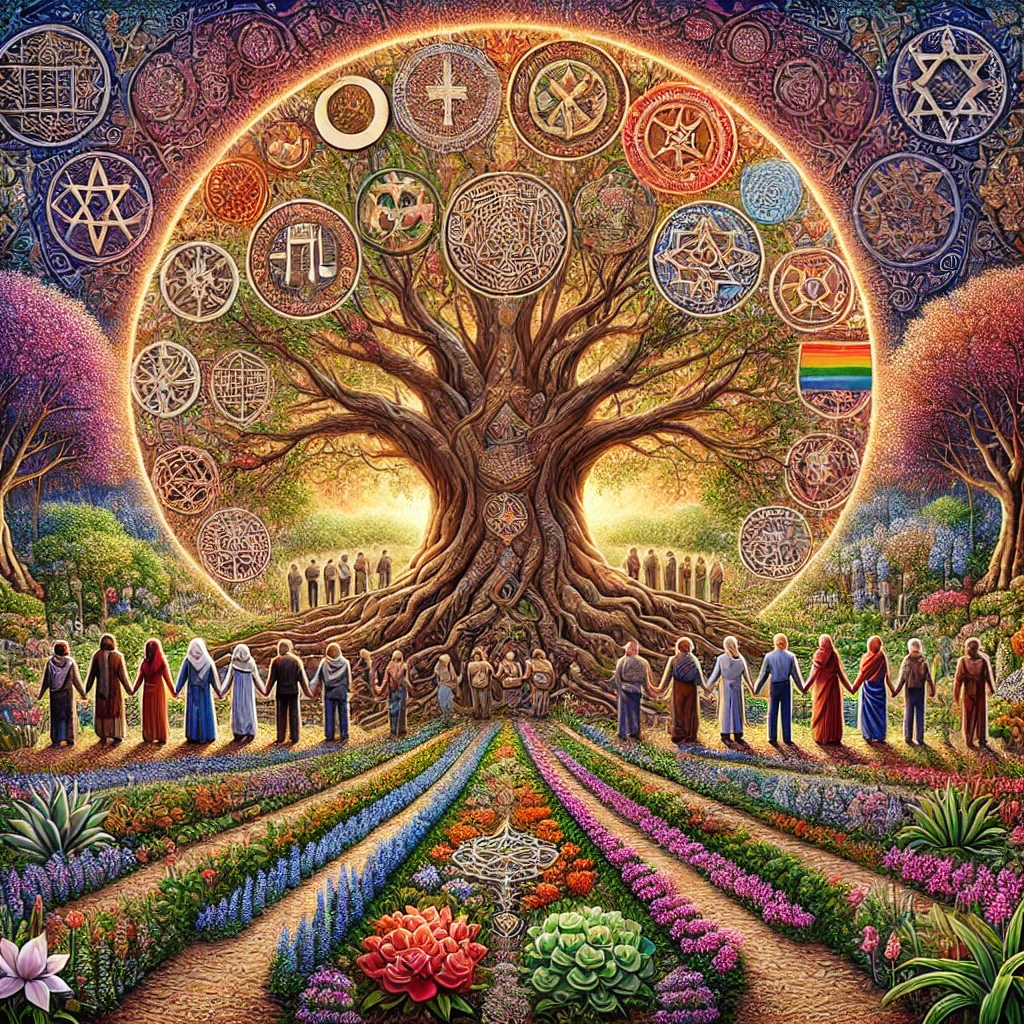
by Community Helper: Sotalo
This week, we’ve talked about a hard subject in BridgeShakers1: how suffering, gender identity/sexuality, and religion combine and conflict with each other. My perspective as a former practitioner and Senior Altar Acolyte of Greek Orthodox Christianity (who also attended Baptist churches in Florida) and lived through several priests, with an ace/gay sexual alignment, and being a Furry, has given me personal insight into these problems. And being the Virtual Furry Museum curator with thousands of conversations with Furries and hundreds of friends, also my passion for history, has given me a unique perspective on these issues.
Over the years, I became less and less accepted by my peers. I had been repressed for decades, and my religion caused me to despise aspects of myself I thought I could change. After the church released an official statement declaring homosexuality degenerate, effectively stating my friends and myself were all degenerate and undeserving of God, it didn’t make me feel God hated us. It made me feel God left the building, and the people within it no longer follow His messages of tolerance and respect: the messages we were taught when we were young. But this isn’t just my story. As you’ll discover, through historical and statistical analysis, this story is reflected all over the world.
The big three monotheistic Abrahamic religions, Judaism (0.17%), Christianity (29.2%), and Islam (23.4%) represent a total of 52.77% of the world’s population.2 These religions have historically wiped and replaced global culture, enacting LGBTQ discrimination and radicalism/extremism. Because of the ancient “thou shalt have no other God before me” rules, the Native Americans, Incans, Mayans, Egyptians, Greeks, and Romans, and native populations all over the world had to give up their mythology and practitioners faded. Most of the world practices one of these three religions, and their heavy prevalence completely supplanted global culture and replaced it with their own. This was very good for certain historical issues, like turning back the death penalty and sacrifices which were common in ancient rituals. During Jim Crow segregation in the United States of America, churches were the most reluctant to follow segregation, citing the Epistle reading of St. Paul’s letter to the Galatians, chapter 3. The Greek Orthodox Archbishop Ivankos of America even marched alongside Dr. Martin Luther King Jr. to Selma for African American voting rights. But these religions did in their time encourage torture, otherism, extremism, superstitions, health issues, and sequestered the LGBTQ community.
Each religion has their own rules, like not eating pork and fasting days, and other issues regarding personal health. Hobby Lobby cited religious freedoms when denying contraceptive care for their employees and won the case. Churches also took it upon themselves to deny funding to stem cell research which set science back on trying to find cures for Diabetes, Parkinsons, and Alzheimers, chronic conditions affecting hundreds of millions within America alone. Sexual expression is highly discouraged, leading to a host of problems among people who have to hide or reject their sexuality and represses populations. It may be possible to draw up statistics for how much life expectancy has fallen due to religious extremism. At one point it was reported 40% of all homeless youth are LGBTQ, so many conservative families are to blame for the rise of orphans and the homeless population. Islamic radicalism became extremely prevalent during 9/11 and the Syrian civil war. More people are now aware of Jewish Zionists fighting Palestinian citizens over claim to Israel. And Christian Nationalism takes hold as Conservative America wages a culture war against the LGBTQ community, enacting 527 anti-LGBTQ bills in 2023, 44 passed into law, and 108 advancing as of 9/23/2024.3
Christianity has a complex history regarding LGBTQ sexuality, and I regard it as being the most historically significant in the rise of homophobia. But it didn’t start that way. For the first 1300 years, the church officially recorded and honored same-sex marriages in the Vatican archive. About 8 years ago, surprisingly, Orthodox Christians were ranked as some of the most accepting of the LGBTQ community (with over 84% reporting accepting gay marriage). Most of the Bible’s anti-LGBTQ messaging comes from Leviticus, the Old Testament book including very conservative laws in ancient times that have no bearing today. Leviticus forbids a man to lay with another man, eating pork, and wearing clothes woven from two threads, but permits slavery. It also says a man who does not provide for a member of his household has denied the faith and is worse than an unbeliever… a law so quickly ignored by those Christians who kick their LGBTQ kids out of their house (my father also kicked me out). It’s important when looking through the Bible to consider the historical context the laws were written: merchants would lie about materials used in clothing, mixing cheap and expensive materials together, in order to falsify and extend supplies. The perspective of denying clothes woven from two threads was intended to disable scummy business practices more than forbidding the development of modern synthetic fabrics. Just because “it is written” does not mean those laws were ordained by God. And much of the Old Testament conflicts with the New. Jesus didn’t fight people who didn’t believe in him, he fought religious zealots who treated people poorly in God’s name. In the Forgiveness of the Adulterous Woman, Jesus came across a scene of capital punishment, the adulterous woman tied to the stake, as the citizens carried stones and lined up to kill her. A priest then scoffed at Jesus preaching forgiveness and pointed to the old laws, showing it was God’s will that the woman actually be stoned to death. But Jesus kept ignoring the man, drew lines in the sand (where the term arose), and said nothing. After being pestered for an answer, Jesus finally arose and said “Alright! But let the man who has not sinned cast the first stone!” It was this moment everyone left. Jesus asked the woman if anyone admonished her, and she said “no.” He forgave her, let her down from the stake, and told her to go and sin no more.
The issue most churches take is the perpetuity of sin and sexuality. Individual acts can be forgiven, but under conservative beliefs living with another man is an admonishment of God’s will. Churches acknowledge sacrifices need to be made to align to God’s will, so people who put their own sexuality in front will never be accepted by the church. As a result, people who are openly gay will not be found in Catholic or Orthodox churches. However, by pointing out the perpetual sin of man, Jesus also pointed out that no one is above the law, and all succumb to it. The early churches were far more forgiving in this regard as Jesus’ disciples were split on what types of marriages to accept. There is more to discuss on this, but the bottom line, Jesus never said anything about homosexuality, and His presence changed things. Churches, over time, varied on their opinion whether to lean more on Jesus’ forgiving nature, leaving judgment to God, and removing themselves from judgment as Jesus so often preferred, or admonishing sin in perpetuity, as Jesus also wished people to turn away from sin in the practice of their life. This is one of many conflicts present within the Bible. The Catholic and Orthodox churches each adopt the ownership of the official interpretation of the Bible over all practitioners and forbid individual augmentations. Therein lies the problem – churches have changed their interpretations over the years, not in accordance with modern science and understanding, but with nothing more than the beliefs of a few cardinals or archbishops and whatever issues they deem worthy to address at the time. We now know gay conversion camps run by churches to force LGBTQ youth into heterosexuality have lead to suicides, undue stress, and repression, where individuals act out or become permanently mentally scarred trying to hide or change their sexuality. This is not the way. Protestant churches vary on their acceptance of homosexuality, with many being even more extremely opposed, and very few being open or accepting.
I could go on with more biblical examples pertaining to sexuality, but to prevent this blog post from becoming an encyclopedia, let’s move on. Sects became more radical over the course of a few hundred years until by the 1300s most churches were opposed to gay relationships. When King Henry VIII signed the Buggery Act of 1533, he made it official: gay was not OK anywhere. And with Britain’s massive empire stretching the majority of the western world, anywhere pretty much meant ANYWHERE!
Various Native American tribes had a variety of practices for people with more than one gender, or Two-Spirits in modern terminology, but many tribes saw these people as capable of performing both male roles of being a warrior and ceremonial leadership, and female roles of crafts and food-gathering. Such roles were heralded by different tribes as such people were considered as having received a special gift from heaven. Well, Puritannical Christians had mounting extremism against LGBTQ sexuality at the time, and together with other rules forced all overt Native spiritual practices to go underground, repressing a once vibrant culture that heralded nonbinary and trans individuals to a status rarely seen in other cultures. This is just one culture that had to change due to Christianity. Italian missionaries changed Mexico. The entire New World entered an era of cultural erasure and assimilation, which would later lead to the erasure of Native people, as well.
If you wonder how so many people could accept Christianity and reject their own practices, even if not by gunfire, some of those ancient practices weren’t exactly ideal, either. Stepping back further, some ancient practices appear absolutely revolting by modern standards: the subjugation of women in ancient Greece, and the pederast relationships between children and mentors. But applying historical context to these views at least makes such positions more tolerable: men were more often physically stronger than women, so chosen to be the warriors, and someone needed to stay behind to care for children. And life expectancy in the ancient world was 20-35 years, leaving a significant plurality of the population underage. If children waited until 30 to have children, their options for living partners would be extremely limited. Many cultures tried to wed children as quickly as possible to guarantee the best success for survival. This is why it’s best not to look at any ancient rules and try to apply them today, where high school pregnancies leave kids struggling to support their families before they can even properly finish their education. So, why look to such ancient rules for wisdom in the world of global communication, advanced scientific discovery, and instantaneous knowledge? Any ordinary person with access to the internet has a greater wealth of knowledge than Napoleon Bonaparte. The world is different now that more people know more things about it and each other. But ancient rules have not kept up, and were not written for today’s society.
There are other issues among people who remain Atheist, like lower levels of reported happiness and contentment with the world. But as religion grows more and more extreme, the problems keep mounting among practitioners and victims, and more and more people are turning their backs away from religion entirely. According to a Gallup poll 47% of Americans identified as religious in June 2023 whereas 32 years ago 87% of young adults identified as religious.4 Religion itself will eventually become a minority if policies are not adjusted to reflect the comprehension and makeup of the modern world. Ironically, young adults waiting until later in life to have children are causing the problem of a larger LGBTQ population! Late childbirth is the biggest attributor to the actual rise of autism and neurodivergence in the modern world, with mothers over 40 having a 51% increase in birthing children with autism. 5 And 15-35% of autistics are on the LGBTQ spectrum!6 The lack of comprehension of gender roles among Autists is one of the biggest links in the broad spectrum of gender identity, (the other, a gene expressing openness). Despite a growing autistic and queer population, conservative religious practices all over the world have been more keen on stronger censorship, discrimination, and extremism, much of it with the intent to remove Autistic and LGBTQ children access to any materials showing the existence of other sexualities. The second most challenged book in America in 2009 was “And Tango Makes Three,” the book dramatizing the true story of two penguin dads raising a son.7 The real story took place in New York’s Central Park Zoo, where penguins Roy and Silo showed desperation for child-rearing and were given an egg to raise. Florida’s “Don’t Say Gay” law prevents LGBTQ subjects from being discussed in K-12 education, completely wiping historical figures and classroom discussions. And these penguins from their bookshelves. Despite those efforts to control education, it’s impossible to revert knowledge back to a world of false assumptions. Despite their best efforts, reality remains a population fundamentally incompatible with religion’s anti-LGBTQ policies.
So, where will religion go in the next 10 years? If things keep going the way they are, extremists will become even more extreme, as Project 2025 has shown. The religious population will continue to dwindle, as people have no use or need for the church. While some churches see success running LGBTQ-friendly practices, these, too, will become trite as religion fails to address and manage relationships in a very modern world beyond the LGBTQ spectrum. Religion is more stable in places like Saudi Arabia which maintains strict adherence to Islamic beliefs at all levels of culture and government, and strictly forbids practice of other religions within the country. Many such cultures restrict and forbid western internet, between iron walls and propaganda to manipulate people into maintaining poor and improper practices. Obviously, Saudi Arabia is not the healthiest picture of religion, enforcing it on society against civil rights and freedoms afforded to western cultures, but they have achieved stability with over 95% of the population identifying as either Sunni or Shiite Muslims. And as if you had to ask, Saudi Arabia honors same-sex marriages with death.
Roger Williams, founder of Rhode Island, once wrote “God’s people are of the willing sort” and rejected the Puritans in their requirement that all are required to worship God and practice the village’s theocracy. He was a staunch supporter of the separation of Church and state. I like to think he was a pioneer for enlightened thinking when it comes to the need for religion in society, and whether or not it would be ideal to pair religious beliefs with governmental rulings. He lived to see the Salem Witch Trials prove that religious belief and legal proceedings do not always mix together well. But, I’ll save that topic for another time.
So, if not the Abrahamic religions, what then will people worship if they wish to remain spiritual? An excellent example of this is Shinto in Japan. Over 100,000 Shinto shrines exist in Japan alone8, and a large portion of the population visits these shrines and practices Shinto rituals. However, only 3% identify as members of Shinto sects9. The rites and practices are more important to modern Japan than doctrine and beliefs. This has led to the rise of Spiritual Tourism, where people often visit the shrines and follow the rites, but do not ultimately believe in the deities or spirits themselves, and do not hold a strong religious connection to Shinto specifically. Many Japanese Shinto practitioners are also practitioners of Buddhism, and use it more for personal guidance and philosophies to better themselves than a rigid belief structure. As Japanese culture continues to spread far and wide, those who wish to remain spiritual and annex the organizational extremism of religion may end up adopting a more Japanese mentality. Those who wish to drop religion from the mind entirely may look to Denmark. The happiest people in the world have no religion. While the church of Denmark is used for funerals and marriages, people don’t follow religious practices regularly, and atheism ranks 46%10. Maybe it’s unrelated, but Denmark also requires all churches to permit same-sex marriages. So, Denmark may be closest to the utopia without religion that describes the vision of John Lennon’s Imagine. Only, I wonder if the absence of all culture and religion is truly a utopia.
I recall my great Chinese college friend Meng, a Bhuddist who believed in reincarnation. We lived in Florida, and bugs often appeared in his lamp, drawn to the light, trapped inside, dead, and piled into each other. He believed people who were bad turned into insects, cockroaches, bugs. When they improved, they turned into beautiful animals, like butterflies, or deer. Not knowing this, I offered to dump the bugs in the garbage. He was so offended! After explaining himself, he made me appreciate life in a way I never had before. The best we can hope for in humanity is cultures where we are all treated as we hope to be treated by others, but that can only happen when we learn to respect others as we hope to be respected ourselves. Whether you learn that lesson from Christianity, Islam, Judaism, Buddhism, Shinto, Hindu, pagan religions, or even lessons that dig into moral philosophy that transcends religion altogether, it is a beautiful lesson to learn. But when religions get lost trying to draw lines in the sand, they end up dissipating in the sands of time. I helped my friend, quivering and saddened by the loss of so many bugs, rinse the lamp cover with water, and buried them into the ground. And, after having completed their lives as bugs, they might return as something even more beautiful. Like a butterfly. It was his time to help them get there. In an instant, he found peace.
BridgeShakers is a sub-initiative within BridgeMakers that focuses on engaging social disruptors early in community interactions, transforming their energy into a catalyst for growth and resilience. Instead of seeing disrupting as a threat, BridgeShakers invites these individuals into conversations that explore their humanity, encouraging healthier behavior through compassion, boundary-setting, and collaborative problem-solving. By reframing disruption as an opportunity for connection, BridgeShakers creates stronger, more inclusive communities where even the most difficult interactions can lead to mutual understanding and transformation. ↩︎- World Population Review: https://worldpopulationreview.com/country-rankings/religion-by-country ↩︎
- ACLU Legislative Attacks on LGBTQ, retrieved 9/23/2024: https://www.aclu.org/legislative-attacks-on-lgbtq-rights-2024 ↩︎
- National Catholic Reporter: How America’s youth lost its religion in the 1990s. Ryan Burge, Apr 19, 2022: https://www.ncronline.org/news/opinion/how-americas-youth-lost-its-religion-1990s ↩︎
- Scientific American: Study Confirms Link between Older Maternal Age and Autism. Feb 11, 2010 https://www.scientificamerican.com/article/autism-maternal-age/ ↩︎
- Spark article Autistic People More Likely to Identify as LGBTQ. rev. Jun 12, 2024 https://www.scientificamerican.com/article/autism-maternal-age/ ↩︎
- American Library Association referenced from CNN blog post Apr 11 2011 ↩︎
- Japan Experience, Shinto & Shrines. Joshua. Feb. 24, 2023 https://www.japan-experience.com/plan-your-trip/to-know/understanding-japan/shinto-shrines ↩︎
- Engler, Price.Historicizing “Tradition” in the Study of Religion. 2005. p. 95 ↩︎
- Statista survey asking “To what extent, if any, do you believe in God?” 1,493 Danes over 18 years of age responded during April to August 2017. Data was released May 2018. https://www.statista.com/statistics/909769/share-of-people-believing-in-god-in-denmark/ ↩︎
Leave a Reply