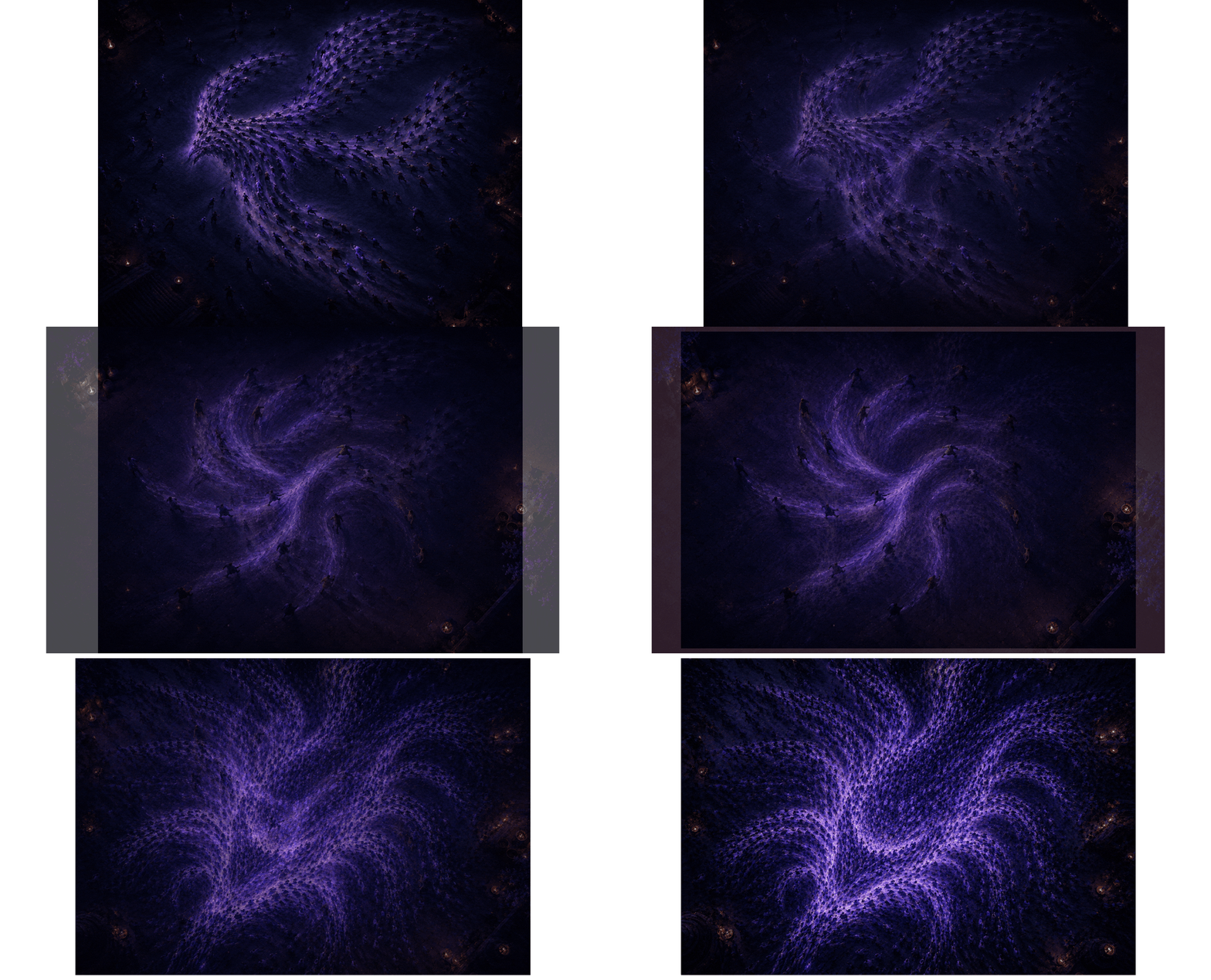
Dancing with the Group Creature
Dancing with the Group Creature
Reflections on Conflict and Resilience at Home, at Work, and in Life
PART I: ENTERING THE FOREST
Chapter 1: The Group Creature Lives
It’s easier to pretend the group is just people.
Just personalities.
Just words.
It’s cleaner that way.
Predictable. Fixable. Linear.
But you’ve already felt the truth.
You’ve felt it when the room changed.
When one person’s story cracked open the air and no one could speak.
When laughter turned sharp and no one remembered the joke.
When your stomach tightened and you told yourself it was nothing, but it wasn’t.
The group was changing shape.
We try to rationalize these moments as awkwardness, tension, or chemistry.
But they are more than that.
They are the signs of a presence forming, ancient, emergent, emotional.
A shared nervous system.
A group field.
A creature.
The group creature isn’t born when people talk.
It’s born when people start feeling together.
When the unspoken becomes the medium.
When your attention is no longer your own, it’s part of the organism.
It has no formal name in most traditions, though you’ll find its fingerprints everywhere, in folklore, in ritual, in ceremony, in riot, in revival.
Some call it the Spirit.
Some, the field.
Some, mob mentality.
All of them are reaching for the same truth.
The group becomes something else.
And if we don’t know how to meet it, it devours us, one-by-one until it is no more.
Circles I Have Sat In
I’ve sat in rooms where this creature came alive, beautiful, terrifying, sacred.
In a psych ward with teens who had more pills than dreams in their veins,
the creature came alive in their silence,
and in the tiny sparks of defiance they offered like lit matches.
In a virtual circle of avatars,
where no one looked like themselves but everyone could feel the fire,
the creature formed ,
not from faces,
but from resonance.
In a family meeting where no one made eye contact,
and everyone kept saying “fine,”
the creature wasn’t just present ,
it was choking us.
These aren’t metaphors.
These are somatic events.
The group creature is real, and you already know it.
The Rules of Becoming
Every time three or more humans gather with shared attention and emotional presence, the creature stirs.
It doesn’t need an invitation.
But it does respond to tone.
To rhythm.
To vulnerability.
It forms through the push-pull of presence.
It speaks in silence and breath.
It watches you speak and listens to the part of you you’re trying to hide.
It remembers everything.
And it will test you ,
to see if you’re paying attention.
You’ve Been in the Belly
Maybe you’re the one who always felt the shift.
The one who asked, “Is something wrong?” and got the sideways glance.
The one who tried to bridge the gap and got ignored.
Or blamed.
Or burned.
Maybe you started making jokes to keep the creature happy.
Or stayed quiet so it wouldn’t look your way.
Maybe you were eaten.
Or exiled.
Or crowned, and hated for it.
You know the creature.
It has no formal name in most traditions, though you’ll find its fingerprints everywhere, in folklore, in ritual, in ceremony, in riot, in revival
It lives in your muscles.
This chapter is not meant to teach you something new.
It is meant to help you remember what your body already knows.
You have danced with the group creature.
Now, let’s learn its steps.
The First Faces of the Creature
As the group creature forms, it doesn’t arrive in full costume.
It starts in flickers.
Glances.
Positions people begin to occupy, unconsciously, instinctively.
Every group has its own gravitational choreography.
No one signs up for their role.
But the creature assigns them anyway.
Someone becomes the Fixer, their eyes dart for solutions before anyone names the problem.
Another becomes the Mute, they feel the tension but bury it under small nods and long silences.
Someone else becomes the Sacrifice, their vulnerability becomes the center the group builds around or devours.
You’ll recognize them not by name, but by rhythm.
By how they lean in.
Or away.
These aren’t yet the full DOT archetypes, those emerge through conflict and transformation.
These are the first masks, the ones the group creature slips over each person to begin its movement.
They are always mythic.
The quiet one might be carrying the seer’s burden, the one who knows but cannot yet speak.
The loud one may be the shield, deflecting, guarding the group from its own grief.
The one who jokes too much may be the bard, laughing to keep the dark at bay.
It’s not who they are.
It’s who the creature needs them to be, until someone disrupts the pattern.
Somatic Truth: The Creature’s First Language
Before the group speaks, the group listens, through the body.
The creature doesn’t care about your theories.
It cares about your pulse.
It reads temperature changes, pupil shifts, breath patterns, posture drops.
It notices when the room tightens.
When three people cross their arms.
When no one breathes for six seconds.
When laughter comes too quickly, and someone’s shoulder doesn’t move with it.
The group creature lives in the nervous system.
A sudden yawn is not always boredom, it might be freeze response.
A neck rub might be self-soothing when someone feels shame entering the space.
Feet turning toward the door are pre-exit rituals.
The creature has no official language.
But the body has never forgotten it.
Your job is not to memorize signs, but to remember how to listen.
Not as an individual.
But as part of a larger organism.
Because when the creature speaks through one person,
it’s often speaking to all of you.
A Moment You May Have Lived
Picture this:
Someone shares something personal, not tragic, but real.
The air shifts.
You feel it.
The room gets quiet, but not peaceful.
Someone else fidgets. Another coughs. A third person smiles too widely and says, “Thanks for sharing.”
It’s polite. It’s kind.
But it’s not real.
The creature knows.
That moment didn’t land.
It cracked something open and everyone tiptoed around it.
You leave the meeting and feel heavier.
Or edgy.
Or confused.
You didn’t do anything wrong.
But the creature is still carrying what no one else would hold.
This is the beginning of recognition.
The next step is learning how to stay ,
not just in your role, but in your resonance.
In the next chapter, we’ll learn to name this dance, track its movements, and begin to work with the creature, rather than reacting to it or running from it.
We’ll start by finding a compass.
We call it the DOT Model.
DEEPEN
The Cave Before the Scream
He saw something he didn’t have a name for: A group that had found something deeper than panic
There was once a village where no one was allowed to cry in public.
Not from grief. Not from joy.
Emotion was considered weather, something to endure silently.
But deep beneath the village was a cave, and they said if you screamed into it, your scream would echo for seven days.
No one dared enter it.
Until one girl did.
She had lost someone, a sibling, a twin maybe, the kind of loss that rearranges your bones.
She couldn’t sleep. Couldn’t eat. Couldn’t stop the noise inside her chest.
So one night, barefoot, she walked into the cave.
She did not scream.
She sat.
The silence inside the cave was a different kind of silence ,
thick, ancient, alive.
She didn’t know how long she stayed.
But when she came out, her body was different.
Her face was still.
But the noise was gone.
Others began to follow. Not to scream. Just to sit.
The village never changed its rules.
But something shifted anyway.
Real Moment One: The Circle of Fog (Youth Ward)
It was my third week facilitating group at the adolescent state hospital.
The kids were new each time. Often medicated. Often mute.
The room always smelled faintly of disinfectant and something more feral, grief, maybe.
That day, no one spoke for ten full minutes.
Not silence-with-a-purpose.
Not meditation.
Just fog.
One girl sat near the corner, curled in on herself.
A boy tapped his foot rapidly. Another blinked at the ceiling.
I felt the familiar pull: Say something. Ask a question. Break the spell.
Instead, I deepened.
Not into strategy, into presence.
I breathed.
I said aloud:
“I’m noticing how quiet it is. My chest feels tight. I think I’m holding my breath.”
Someone coughed.
Another shifted.
I waited.
Five more minutes passed.
Then the girl in the corner said:
“I didn’t think you’d let the quiet stay.”
That was the first join-up.
She told her story the next day.
The group changed after that.
Real Moment Two: The Fire That Couldn’t Break Us (Adult Chronic Unit)
There was a day on the adult chronic unit, the “throwaways,” some called them, where a group moment reached such deep coherence, we were barely breathing.
These were people who would likely never leave the facility.
Trauma ran deep. Language came slow.
But that day, something had opened, a seam between the unspoken and the shared.
Then: the fire alarm.
Ear-splitting. Screaming klaxons.
The entire hospital began its emergency shuffle, staff rushing, patients exiting, lights blinking red.
But in our room, no one moved.
We just sat there, in full presence, not frozen, but anchored.
Looking at each other. Or at the center of the table.
Breathing. Holding. Staying.
For a full minute, we remained, while people ran outside the glass, glancing in at us confused by our stillness.
When staff burst in, wide-eyed and urgent, the spell slowly lifted.
We stood, orderly. Calm.
The staff member looked stunned.
He saw something he didn’t have a name for:
A group that had found something deeper than panic.
A silence louder than alarms.
I will never forget that moment.
Bridge: What It Means to Deepen
Deepening is the most unseen phase of group dynamics, because it looks like nothing is happening.
But that’s the illusion.
Deepening is the descent beneath reaction.
It’s what happens when a group, or a facilitator, refuses to escape the discomfort too quickly.
When the world says, “Move!”
Deepen says, “Breathe.”
It was a build up and every once in a while, the color that it was changed to happened to be the color that had been started
When the fire alarm says, “Flee!”
Deepen says, “Listen.”
It is the sacred pause ,
The space between the inhale and the exhale,
between the urge to speak and the choice to sense.
In some ways, that hospital was the cave ,
echoing with decades of psychic screams from souls abandoned, silenced, restrained.
When we sat in that fire-drill moment and did not flinch, we became the stillpoint those echoes could land inside.
The next week the same people returned to the group for the first time, they remembered something more had happened in our group before. They brought their friends. The table was crowded. I bowed my head and set an intention outloud, softly, curiously. “I wonder what would happen if we all just made a tiny choice to be here right now, just a little bit more. What would that look like?” Then I would share a story that had transparent skin, one I was not prepared to share, one that came to me in the moment, tapping me on my shoulder and bowing softly while whispering ‘use me.” The key to the stories I tell is that I am discovering the end of the story with you, I don’t yet even know if it will be useful for the moment we are in. Sometimes it is not, and can bring confusion and distance with those present. “What is one thing you feel right now in your body or emotions?” I would ask. Around the room, one by one, people would try. Leaning in, sometimes only making noises as their contribution, others saying a few words that were loosely connected (e.g., “trampoline, glasses, spiral”), still others saying an emotion or a body sense. Some held very still when it was their turn, it was as if they had turned into statues, as if they were a bunny and a ghost, quivering in fright of being seen, but dissolved into a fog of undoing; most barely hoping that they will ever be seen again. I paused with them, and coaxed and coached them to try. Realizing the group had very little practice feeling their feelings, especially the uncomfortable ones, I invited them to build a feelings treasure chest and find the treasures within them that could help them feel even the hard feelings with a confidence that they would last longer than the feeling. I invited them to consider that the quickest way through a hard feeling was to give it time and air to breath and be seen.
We learned together about metaphor, and how sometimes painting a picture with words starts with something as simple as a color or a sound. We tried using both of these in silly and creative ways. We drew with crayons and pens as we made a noise, we played a game called color snake, Similar to playing telephone, people sitting in a circle would tell each other a color by and whispering it into their ear. The listener could pass that color on, or change it and whisper something different in the next person’s ear. Some in the room begrudgingly participated in this, but did so anyways to humor those who were excited to play the game. This gave everyone a chance to help each other, and also be a trickster if they so chose. At the end of the circle, the final person would say the color they heard (or changed the color to) out loud. It was a build up and every once in a while, the color that it was changed to happened to be the color that had been started. The room would erupt in a roar if this happened.
When people came the next week and we checked in, some of them checked in by saying what color they were. At the end, some of the people who hadn’t been there the week before caught on and decided to check in as a color and say the thing they wanted to say. Sometimes people would come back week after week and say different shades of a color, some even researched new color names and came just to share what they had learned. Eventually, for repeat group members I would tug on them to tell me a thing that the color was like. A person might say “today I am the color of dark green.” I would nod with brevity and then say, “I’m so curious, dark green like a tractor? Or dark green like a pine tree?” Sometimes they would pick one of the options, other times they would spontaneously argue by telling the real story of the color. Their air of defiance had so many cycles of dehumanizing trauma inside it. They were the girl in the cave listening for the screams of my undoing. Instead, I bowed my head and said, wow, I really got that wrong, didn’t I? They had won, and the whole table looked at them with respect. Still looking down I would ask “what other colors are in the room?” More and more people came to the group, sometimes just to tell us their color and leave. This story is one small patch in an endless quilt of encounters I had at that hospital. There was a liminal terror to that space, and it required a presence of gratitude to walk those halls in grace. I say that because I felt more alive there than any past moment in my life. I felt like it was taking all of me 100% of my attention and forgiveness and belly breaths to be with these people and not succumb to fear and loathing.
Practical Recipe: How to Deepen in Group Life
To deepen means:
Noticing that a charge has entered the space, tension, silence, intensity, and not immediately filling it
Practicing emotional intelligence by locating what you’re actually feeling: fear, shame, grief, confusion
Naming a body truth aloud: “My chest is tight.” “I feel like I want to run.” “Something just shifted here.”
Lowering yourself emotionally, not to withdraw, but to meet the energy from underneath. (Think: grounding, not collapsing.)
Trusting that presence is an intervention, and that staying with the discomfort is already movement
Deepening does not mean staying stuck.
It means honoring the descent before climbing the ladder.
It is the root system.
Without it, orientation is shallow. Transformation is performative.
The group creature trusts those who can deepen.
Because it knows they won’t flinch when it bares its teeth, or its wounds.
ORIENT
The Girl and the Melted Compass
In a land where green once danced in the wind and birdsong filled the air, there came a fire so vast it seemed to swallow time itself. It burned not only the trees, but the stories, the trails, the sky. What remained was soot and silence.
A girl wandered alone through this ash-gray world, her small hand clutching a compass, an heirloom once used by her grandmother to find water, used by her mother to find safety. Now, its needle spun endlessly, disoriented by the heat that had melted the ground it once read so well.
She walked for days. Dust coated her eyelashes, and her breath grew ragged. Eventually, she curled beneath a broken tree stump, the earth still warm from what had passed. She lay on her side and held the warped compass to her chest like a child’s final prayer.
As sleep overtook her, she whispered to it, “Show me the way that is still true.”
No reply came, only the rustle of wind across dead branches. But beneath her, in the silence, something ancient stirred. A pulse. Faint. Steady.
Roots.
Though the trees above were gone, the roots remained, alive, humming in the deep. Not broken, but waiting. Remembering.
In her dream, she felt them, entwined with the earth’s rhythm, mapping paths beneath the soil. When she awoke, nothing had changed around her. And yet, she rose with new clarity. She no longer looked to the compass. Instead, she placed her bare feet on the earth and listened.
She would not walk by direction now, but by pulse.
The Group Encounter: Shadow at the Edges
In a gathering of grassroots facilitators, someone posed a heavy question: “What do you do when someone shares something they’re proud of… but you think they may have harmed someone?”
The room shifted.
A participant began to laugh and started to name someone known to be difficult. But before the energy fully unraveled, the facilitator interrupted, not with condemnation, but with gentle disruption.
“Pause,” they said. “What we’re doing now is turning someone into an archetype, a shadow we all point to, outside this moment. But we used their name. And now they’ll walk into every room we hold, no matter where they are. They’ll behave more and more like the archetype we’ve cast them into, without even realizing it.”
A stillness followed.
The facilitator continued, “Imagine instead that you’re meeting different versions of that person in different realities. One version harms. Another is healing. A third is just… confused. What matters most is not which version is ‘real.’ What matters is what their presence is drawing out of you. That’s where the work is.”
The group leaned in.
And in that moment, they began to feel the ground beneath them, not the surface tensions, but the deeper pulse: the group creature stirring, roots brushing against roots, reaching for new understanding beneath the soil of shared space.
What It Means to Orient
To orient is to pause.
Not to rush toward clarity, but to wait, long enough to feel what’s moving under the surface. It’s the first step in any true encounter, especially in group work. It means recognizing when old tools no longer serve, the compass that once guided you may now only confuse. It means whispering to the unseen, “Show me the way that is still true,” even when there’s no map.
Orienting is not passive. It is active listening with the soul. It’s the choice to trust the pulse, of the body, of the group, of the living world. It’s how we find a center when the known has melted, and it’s how we begin to remember that the ground is not dead, only dormant.
This is the foundation of working with group creatures. Before we name, before we analyze, before we intervene, we listen. We orient.
And sometimes, the first truth we must hear is this:
You are not lost. The roots beneath you remember.
Here is the Orient triptych, in the same spirit and structure as Deepen, a myth, a moment, and a method braided together to illuminate what it means to re-center in the fire.
ORIENT
The Compass in the Ashes
Long ago, there was a kingdom destroyed by fire.
The forests turned to cinder. The river to steam.
The people scattered.
In the ruins, a child wandered alone.
She did not cry. She did not run.
She walked, slow, deliberate, barefoot across the blackened soil.
In her hand, she carried a compass.
It had once belonged to a cartographer, her grandmother, who told stories of stars and ley lines and mountain crossings.
The compass needle was melted now. Useless, said the few survivors she passed.
But she kept it.
Every night, she placed it on the ground beside her before sleep.
And every morning, she whispered to it:
“Where is the way that is still true?”
One morning, the needle moved.
Not north. Not anywhere known.
But it pointed.
She followed it.
And others followed her.
It’s how we find a center when the known has melted, and it’s how we begin to remember that the ground is not dead, only dormant
They didn’t rebuild the kingdom.
They built something else.
Real Moment: The Question That Opened a Path
In a similar moment to the one above, an unconscious venting by a group member about someone outside the room, cracked the group bubble open unexpectedly.
Someone shared a story about a harm they had caused, but didn’t seem to realize it was harm to share the story that way.
There was laughter. A kind of bravado.
The group tensed. I could feel the creature flinch.
People began to freeze, or make small awkward gestures, the shuffle of those who don’t want to confront but can’t agree.
Inside me: heat.
I felt the urge to jump in. To fix it.
But I remembered the map.
Instead of reacting, I oriented.
I changed my tone. Slowed my voice.
And said:
“I notice my values are really activated right now. I’m feeling discomfort in my belly. I want to check, are we hearing this story the same way?”
There was a pause.
And then someone else said,
“I thought it was kind of messed up.”
Another said:
“It reminded me of something that happened to me, and I didn’t like how it felt.”
We didn’t shame the sharer.
We reoriented the field.
The compass turned.
The group found its center again.
Bridge: What It Means to Orient
Orientation is not correction.
It is remembering where we are, and what matters now.
In the myth, the girl holds a broken compass.
But her question is everything:
“What is the way that is true?”
In group life, orientation means asking the same, aloud, somatically, relationally.
It’s the moment you realize:
This isn’t just discomfort. This is a fork in the road.
We can’t go forward on auto-pilot.
We must split away or reach towards each other, into a shared value, a body cue, a breath, a human story, a north star.
The VR group didn’t need a correction.
It needed a recalibration.
The compass, in that case, my own somatic signal, helped us all find footing.
No one was exiled.
No one was made a villain.
But the creature changed direction.
That is the power of orienting.
Practical Recipe: How to Orient in Group Life
To orient means:
Acknowledging your own body’s signals and values as information, not intrusion
Asking open questions that surface what others may be sensing but not yet saying
Naming shifts in energy without assigning blame (“Something feels different here.”)
Offering gentle friction, not as critique, but as a mirror (“My values are waking up here, I want to pause.”)
Trusting that clarity is more valuable than comfort, and that discomfort doesn’t mean disconnection
Orientation is the moment between instinct and intention.
It slows the spiral.
It chooses where to turn, rather than letting the strongest voice pull the group off-course.
If deepen is the root,
then orient is the trunk, the steadying presence that helps the group rise without snapping in the wind.
Here is the final DOT triptych, for Transform, completing the arc.
This one brings the spiral to its soft and sacred close. It honors that transformation is rarely what we think it is, not triumph, but molting, disorientation, reconstitution. Not drama, but dignity in presence.
TRANSFORM
The Boy and the Molting Serpent
A boy lived on the edge of a marsh where serpents came to shed their skins.
He wasn’t afraid of them.
He watched them curl around rocks, still and strange, as their old skins split like paper.
One day, he found a serpent halfway through its molt, stuck.
The old skin hung in shreds. The new one blood-slick and exposed.
The boy reached out, thinking to help.
But the serpent coiled, hissed, writhed.
He stepped back.
So instead, he sat.
He stayed for hours. Days, maybe.
He offered no touch, only presence.
No words, only breath.
Eventually, the serpent stilled.
Then, with a long, terrible shudder, it pulled free.
Sometimes it looks like someone quietly saying, “I feel different now.” If deepen is the root, and orient is the trunk, then transform is the canopy, wide, open, connected to sky and time
And left the old skin beside the boy.
Later, a trail of others found him, having heard stories about the boy who called suffering his friend. They asked him how to help creatures in pain.
He said:
“Sometimes the only help is staying near while they become.”
Real Moment: The Facilitator Who Wept with the Group
I was co-facilitating a community group for facilitators in training, people who were supposed to be “holding space” for others.
One day, a participant shared a story that was not just hard, it was harmful.
They didn’t know it. Or maybe they did.
The energy in the room collapsed.
Several people froze. Others dissociated.
A few began to fidget, visibly dysregulated.
The facilitator froze too.
I watched as they went pale, then flushed, then folded inward.
I prepared to step in, but something in me said, wait.
Then, slowly, the facilitator raised their eyes.
Tears had filled them.
They said:
“Something in me broke just now. I don’t know how to guide this. I’m scared I’m going to do harm by trying to fix it.”
Silence.
And then someone said:
“That’s the first thing that felt true since the story was shared.”
The group didn’t solve the conflict that day.
But we found the moment of transformation.
Not through control.
But through revealing the molt.
The facilitator didn’t save the group.
They became part of it, vulnerable, raw, willing to stay through the shedding.
Everything shifted.
Bridge: What It Means to Transform
The serpent story isn’t about snakes.
It’s about what it means to be witnessed in the middle of change, not when the story is tidy, but when it’s still wet with fear and shame.
Transformation doesn’t begin when a group reaches resolution.
It begins the moment someone chooses to stay present when presence feels unbearable.
The facilitator in that group didn’t offer insight or instruction.
They offered truth without control.
They let themselves be seen, not as a guide, but as a human being in process.
And that created the opening.
In the DOT Model, this is what transformation means.
Not fixing.
Not resolving.
Becoming, together.
And sometimes, becoming means molting in front of others,
and letting the room hold what peels away.
Practical Recipe: How to Transform in Group Life
To transform means:
Staying in the process long enough for something to change you
Naming moments of vulnerability and uncertainty aloud, as sacred data
Honoring rupture as part of relationship, not proof of failure
Making meaning with others, not delivering meaning to them
Allowing emotional honesty to coexist with structure, timing, and rhythm
Transformation doesn’t mean everyone agrees.
It means something honest has happened, and the group has witnessed it.
Sometimes that looks like a breakthrough.
Sometimes it looks like someone quietly saying, “I feel different now.”
If deepen is the root, and orient is the trunk,
then transform is the canopy, wide, open, connected to sky and time.
This is where the group creature reveals its truest form.
Not as a mirror, but as a midwife, helping us become who we could not become alone.
Conclusion: The Group Creature Lives
So if you’ve ever sat in a room and felt the air change ,
if you’ve ever said too much or too little and then wondered why it felt like the walls themselves were listening ,
if you’ve felt a chill when laughter came too fast, or warmth when silence wrapped around someone’s grief ,
you have already met the group creature.
You know it.
You’ve danced with it.
Or been devoured by it.
This creature isn’t imaginary.
It’s not an idea.
It’s a presence, felt in your muscles, in the tremble of your voice, in the moment your gut clenches before anyone speaks.
The group creature is not here to be mastered.
It is not a threat to neutralize or a spirit to summon.
It is a shared nervous system with needs, instincts, and intelligence of its own.
But when norms turn quickly to rules, when safety becomes silence, when difference becomes danger , that’s when you know: the creature is scaled like a dragon
It will shape you if you let it.
And if you ignore it, it will find another way to speak.
But there’s something else.
When we learn to recognize the creature,
when we learn to listen to it,
when we learn to stay with it long enough ,
not as enemies or performers, but as witnesses ,
the creature doesn’t just unsettle us.
It guides us.
It calls us into transformation, one that isn’t available in solitude.
And for that journey, we need a compass.
Something that honors the mystery but helps us navigate the sacred mess.
Something born from lived experience, not theory.
Something you can feel in your hands when the group starts to heat, or freeze, or fracture.
That compass is the DOT Model.
Before we cross into that map, I want to tell you one more story.
The One Who Rode the Sky Lizard
In the film Avatar, the outsider, Jake, is preparing to bond with a flying creature called an Ikran.
It’s a rite of passage.
To fly, one must first be chosen.
And Jake, nervous and uncertain, turns to his guide and asks:
“How will I know if it has chosen me?”
The guide responds, without blinking:
“It will try to kill you.”
The creature will resist.
It will fight your presence.
It will test your rhythm, your readiness, your fear.
And if you stay, long enough, open enough, honest enough, the bond forms.
Flight becomes possible.
But not because you mastered the beast.
Because you became part of it.
That story isn’t about a dragon-lizard on a floating mountain.
It’s about what happens in every group
when the collective body begins to stir, and someone dares to lean in.
Jake deepened, embedding in the culture.
He oriented, aligning with new values and power lines.
He transformed, but only by risking the death of the self he had known.
This is what awaits us in real group work.
Not dragons, but something just as ancient.
The group creature chooses us when we are willing to be undone.
Learning to Fly with the Scales
Since the days of my first mentorship, sitting beside a woman who held group rooms like a symphony conductor with no score , my teachers have changed.
Now, I am mentored by the group creatures themselves.
You can see their fur or feathers in the norms that form quietly in a group, how people greet, pause, disclose, return.
But when norms turn quickly to rules,
when safety becomes silence,
when difference becomes danger ,
that’s when you know: the creature is scaled like a dragon.
It has slipped into its lizard brain.
It is preparing for battle.
This doesn’t mean the group has failed.
We can never leave our lizard selves behind.
The parts of ourselves that simplify the world
into black and white, right and wrong, who is in and who is out.
But we can bond with them.
Like Jake with the Ikran, we do not cut off the primitive.
We dance with it.
We yield to its testing.
And in that surrender, we find lift.
When we deepen, orient, and transform together,
we become capable of emotional flight ,
looping through synergy, rupture, repair, silence, grief, and joy.
We land, not as the same people who took off,
but as vessels that carry others with us as we grow.
This is not a method.
It is a remembering.
It is the wild beauty of when we becomes us and now.
And to move through it, you will need a compass that lives in your body as much as your mind.
This is where we begin.
- The DOT Model: Compass for the Sacred Mess
Deepen → Orient → Transform, a cycle, not a linear tool.
Each phase is archetypal: descent, crossroads, metamorphosis.
How it was born from broken institutions, and deep presence with pain.
The Mentor and the Music Tell the story of being mentored by the sister of a famous star
Introduce the six archetypes:
Challenger (truth-breaker)
Creator (pain-alchemist)
Coach / Butterfly (pattern-seer)
Connector (field-weaver)
Contractor (edge-setter)
Container (depth-holder)
Symbols, somatics, and shadow signs of each.
- The Lenses of Empathy: Micro, Mezzo, Macro
These are your listening eyes.
Micro: Emotions, body, relational echoes.
Mezzo: Group rhythms, relational choreography.
Macro: Structural patterns, history in the room.
Exercises to discover your primary and secondary lens.
Readers are told: Begin where your ache or awe is loudest.
- Lineage: Those Who Whispered First
Honoring those who mapped pieces of this path:
Irvin Yalom, group process and existential presence.
Gestalt and Somatic lineages, body-first knowing, the here-and-now.
Systems thinkers, trauma theorists, spiritual rebels.
Acknowledging what they could see, and what they could not.
The difference between teaching from the wound and from the scar.
- The Mentor and the Music
Tell the story of being mentored by the sister of a famous star.
Her invitation: “What do you want from this connection?”
“Not a therapist. A mentor.”, And she said yes.
Learning by sitting beside her, by watching the unspoken layers of facilitation.
Meeting her mentor, the lineage deepening.
The blind pianist metaphor:
“You are a concert pianist but cannot read music.”
Her grace in hearing this truth: “You will teach people to read the music.”
this learning cloud is that attempt, a written score for an invisible song.
PART II: THE DANCE OF DYNAMICS
- Power, Privilege, and Cultural Rituals of Access
Who is allowed to storm, to speak, to be soft?
The cultural scripts that determine group roles long before words are spoken.
Tuckman’s stages reframed through identity and access.
Myths of exile, divine punishment, and forgotten siblings.
- Deepen: Descent into the Emotional Underworld
Emotions as intelligence.
The group creature senses fear, guilt, grief, and mirrors it.
The danger of bypassing, the wisdom of staying.
Metaphor: Inanna’s descent, being stripped of titles at each gate.
- Orient: The Compass and the Storm
Holding complexity without collapse.
Naming discomfort without blame.
Breath, body, values, finding orientation in dissonance.
Archetypal moment: crossroads, riddles, trickster medicine.
- Transform: Compost, Conflict, and Creation
Conflict as catalyst.
How the group creature evolves or dies.
When each archetype shows up transformed.
Rituals of repair, not to erase harm, but to metabolize it.
Myth: the Phoenix that rises from its own ash.
PART III: THE CALL TO FACILITATE
- Becoming the Music
The facilitator is not a conductor, but a tuning fork.
Archetypal echoes in the self: when you carry all six roles.
Stories from facilitation moments where silence said more than any model.
- When It Breaks: Violence, Exile, and Endings
When the creature becomes abusive.
How to see structural harm and not mistake it for “group tension.”
Naming thresholds: when to stay, when to leave, how to close.
Rituals for ending with dignity. What a good goodbye feels like.
- The Myth You Carry
Create your own myth of conflict.
Exercises for remembering your personal group creature story.
Story as spell, what you tell shapes what you become.
Invitation to readers: What song will awaken in you, when the next creature arises?
EPILOGUE: If You Forget, the Body Will Remember
A blessing for the ones who hold space.
The ache of trying to write the wind.
May this learning cloud awaken in the moment your mouth goes dry, your heart races, and silence falls.
May the group creature meet you there, and know you as kin.
APPENDICES
DOT Model diagrams and archetype maps
Empathic lens discovery prompts
Somatic check-in templates
Rituals for gathering, rupturing, and closing
Scripts for truth-telling in awkwardness and grace